Is a Glass Jar Really a Good Home for Your Tea?
Brewing & Storage|Author:祥興茶行|Published:2026-04-07
Glass jars make tea look beautiful — and quietly ruin it. A beginner-friendly guide to why light is tea's worst enemy, and what to store your leaves in instead.
Is a Glass Jar Really a Good Home for Your Tea?
A relaxed, easy-to-follow storage guide for anyone just getting into tea
The Short Answer First
Glass jars are beautiful, and tea looks wonderful in them. But from a scientific standpoint, glass is tea's enemy.
Why? By the end of this article, you'll know exactly why.
What Is Tea Afraid Of?
Once tea is harvested and finished, it doesn't just sit there in a "frozen" state. Its internal chemistry keeps shifting in response to the environment. Five factors degrade tea faster than anything else:
Threat | What It Does
Light | Destroys aroma and color — and does it fastest
Moisture | Makes leaves damp and prone to mold
High temperature | Speeds up every chemical reaction, aging the tea
Oxygen | Oxidizes the leaves and flattens the flavor
Odors | Tea readily absorbs whatever smells surround it
Of these, light does the most direct and rapid damage — and that is precisely the glass jar's biggest flaw.
How Does Light Damage Tea?
Where "Sun-Struck" Flavor Comes From
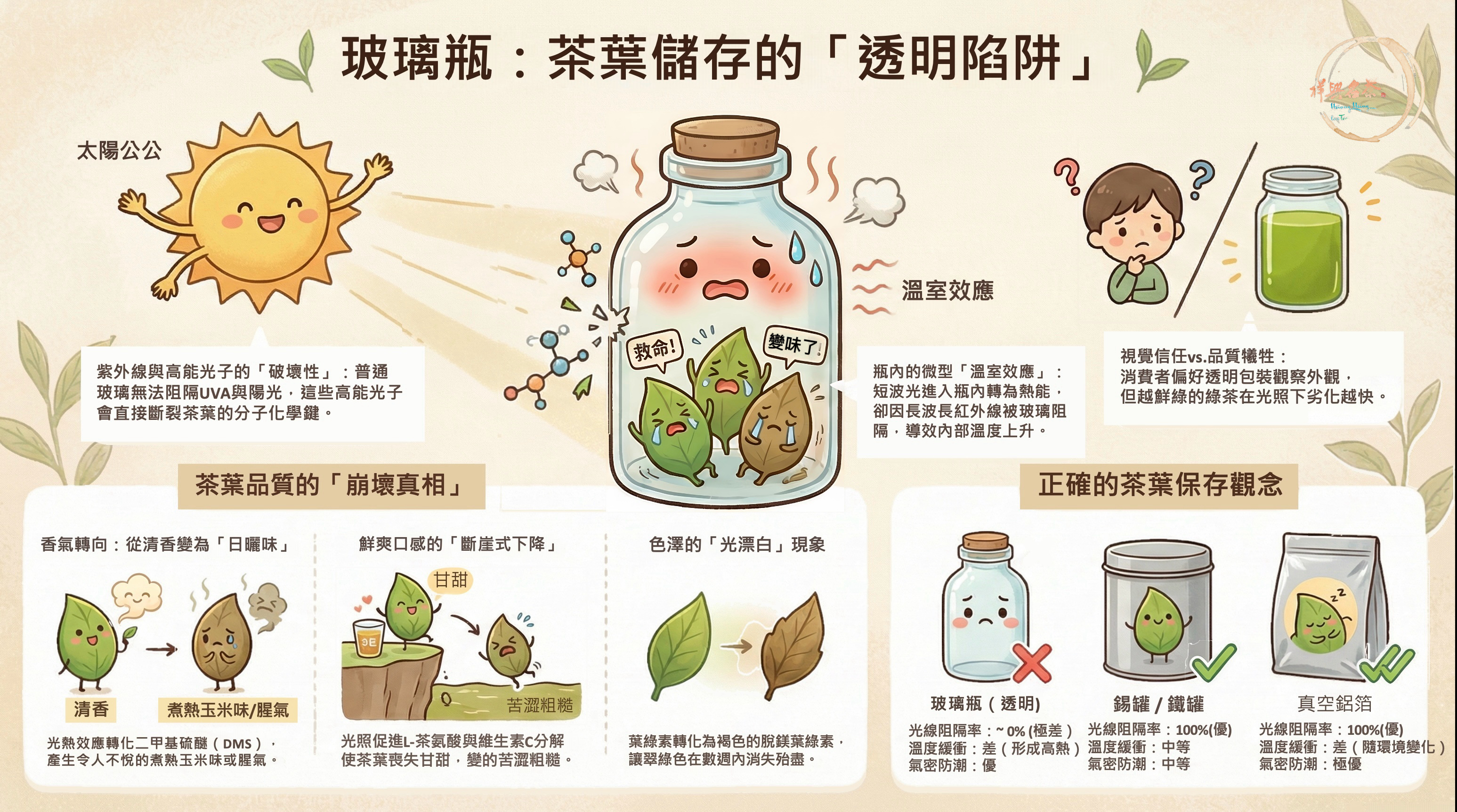
Have you ever smelled a tea with an odd note, something like overcooked corn left out too long, or a faintly fishy off-aroma? That's what tea people call "sun-struck" flavor.
Tea contains a compound that breaks down under light and heat, releasing a gas called dimethyl sulfide (DMS). The nose picks it up with remarkable ease, and once it forms, there is no getting rid of it.
Tea stored in a clear glass jar spends far more time exposed to light, so sun-struck flavor develops that much faster.
The Green Fades Away
Green tea owes its vivid emerald color to chlorophyll. Under light exposure, chlorophyll loses its structure, and that lovely green dulls into a drab yellow-brown.
This isn't just cosmetic. It signals that the tea's nutrients and flavor have already begun draining away.
Research has found that green tea kept in a clear container suffers as much color degradation in a few weeks as tea stored in the dark does in over a year.
The Fresh Sweetness Disappears
The fresh, brothy sweetness of high-quality tea comes largely from a compound called theanine. It, too, is light-sensitive and breaks down under exposure.
Once the theanine is gone, so is its job of balancing out bitterness — and the cup starts tasting harsher and more astringent.
Glass Jars Have Another Problem: The Greenhouse Effect
Sunlight passes through glass into the jar, where the leaves absorb its energy as heat — but that heat struggles to escape back out through the glass. It's the same reason a parked car in the sun gets far hotter inside than out.
Experiments show that a clear glass jar sitting by a window can easily exceed 35–40°C inside, even when the room is only 25°C.
Heat accelerates aging, "cooking" a tea's fresh, lively aromatics into something dull and losing that bright, brisk character.
How Different Teas Fare in a Glass Jar
Green Tea — The Hardest Hit
Green tea retains the most of its natural compounds, which also makes it the least stable. In a glass jar:
- Color: vivid green → yellow → brown
- Aroma: the bean and chestnut notes fade, replaced by sun-struck off-notes
- Taste: the fresh sweetness vanishes, leaving only bitterness and astringency
For celebrated greens like Longjing or Biluochun, a glass jar amounts to fast-tracking the destruction of everything that makes them special.
Black Tea — The Liquor Goes Dark
Black tea is already oxidized, but its bright golden-red liquor depends on compounds called theaflavins. Light oxidizes theaflavins into darker substances, turning the cup from brilliant amber-red to murky dark red, while the aroma slides from floral and fruity into a flat, scorched heaviness.
Pu-erh — The Microbes Take a Hit
Pu-erh's charm lies in how it transforms over time, a process that depends on specific microorganisms. Ultraviolet light is germicidal: with long-term exposure in a glass jar, the beneficial microbes on the tea's surface are suppressed and the normal aging process gets interrupted.
White Tea — Aging Down the Wrong Path
White tea is prized for growing "more fragrant with age," but that only happens under the right conditions, slowly. The heat and light of a glass jar push white tea down the wrong aging path — it develops fishy off-notes and never gains the medicinal-herb and jujube aromas it should.
So What Should You Store Tea In?
Container | Light Protection | Moisture Protection | Heat Insulation | Verdict
Clear glass jar | ✗ None at all | ✓ | ✗ Poor | Not recommended
Dark (amber) glass jar | △ Partial | ✓ | ✗ Poor | Barely passable, short-term
Tin caddy / double-walled metal tin | ✓ | △ | △ | Recommended
Foil pouch (vacuum-sealed) | ✓ | ✓ | ✓ | Strongly recommended
Ceramic jar (lidded) | ✓ | ✓ | ✓ Good thermal buffer | Recommended
Why Are Foil Pouches So Good?
A laminated foil pouch, combined with vacuum sealing, can bring the oxygen inside below 1% while blocking light completely. An environment like that can extend a tea's lifespan two- to threefold.
If You Really Want to Use a Glass Jar
Some people simply love the look and feel of glass — and that's fine, as long as you follow a few rules:
- Keep it somewhere completely dark — a closed drawer, say, or the back of a cupboard
- Choose deep amber glass — it filters out the most destructive ultraviolet light
- Limit how much you store — only as much as you'll drink within two weeks, minimizing prolonged light exposure
- Add a desiccant packet — to offset the moisture risk from a glass jar's larger headspace
The Takeaway: Four Words for Storing Tea
Good tea storage comes down to four words:
Dark, low-oxygen, stable temperature, dry
- For green tea, where peak freshness is everything: a foil pouch in the refrigerator (0–5°C) is your best bet
- For pu-erh and white tea, which need to transform slowly: choose a ceramic jar or sturdy paper storage that can "breathe" — kept away from light all the same
Save the beauty of glass for the moment you brew. For storage, let your tea rest somewhere dark, cool, and quiet.
This article draws on materials from the Tea and Beverage Research Station of Taiwan's Ministry of Agriculture, along with published research in food chemistry and packaging science.